Yesterday, in my Art of Mexico in the Age of Conquest class, we discussed the Mesoamerican view of deity. As a person looking for a God who is found at the heart of all reality, I am often fascinated by the spiritual views of people uninfluenced by the western, European church. I often wonder what happened to the hearts of the people far from the middle east and unassociated (and unknown by) the people most closely connected with the person of Jesus. I want to know if and how God manifests himself to these people and I want to know what they did with the image of God and the imprint of his breath on thier faces and hearts.
This class I am a part of is an interesting one as it adresses the nature of the culture of Mesoamerica before the visit from the Spanish, the interaction between Mesoamerican and Spanish culture, and finally, the new cultural heritage that resulted from the intersection of these people groups. Much of the information we do have about the Aztec people comes from records actually taken by Spanish missionaries (after the original indiginous records were detroyed), which did set out to accurately portray the lives of these people, but these records do also contain some bias emposed by the Western slant on reality.
Anyway-- the thing I found most compelling in the understanding of the Aztec understanding of "gods" or "deities" is its contrast to the western or Roman idea of gods as separate beings, residing in myth or elsewhere. To the Aztecs, thier "idols" or god-figures were more realted to types of essences found in nature or reality. The sculptures they made of certain "gods" as we would call them were considered to be more embodiments or icons describing the natural elements such as rain, fire, wind, or earth. They believed in a certain sort of life-force filling the manifestations of nature and thier environments. The had no notion of sacred v. secular-- everything was connected for them.
Another interesting idea that set a major backdrop for Aztec life was the absence of opposites or opposing concepts. Much of their imagery depicts a marriage of agriculture and fertility to death and sacrifice. They held this strange idea that life can only come from death. Now, for them, that did often manifest itself in terms of human sacrifice, which I certainly do NOT advocate, but I think that perhaps this idea of connecting these sorts of ideas is very profound. They were not as interseted in defining things and choosing sides as they were interested in wrestling with the tension between these aspects of life that seem both controdictory and inseperable.
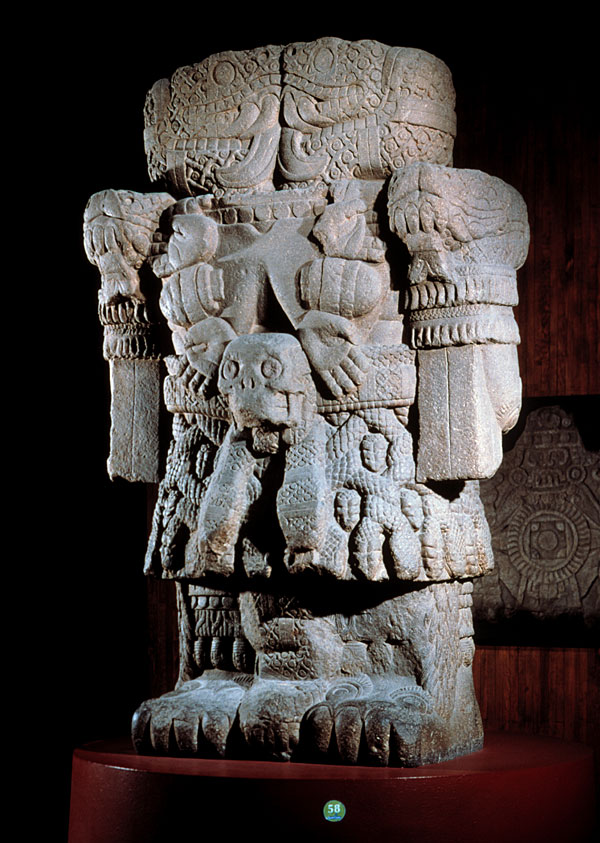
Yesterday in class, we were looking at a carving of Caotlicue (pronounced co-at-li-que), or "She of the Serpent Skirt," which was their metephor, or teotl, for the earth and discussing how the Spaniards would have responded to such an image-- due to certain details of myth, the figure is missing her head, which is replaced by two writhing snakes, she sports large claws, wears a skull as a belt, and is adorned with a skirt made up of snakes. Although the Aztecs did take some enjoyment in frightening people, this is not neccessarily the major intent here. I imagine the Spaniards coming from a land of icons of the Virgin and beautifully ordered and contained catherdrals to this sort of undefinable figure of power.
I am struck here by the Aztec ability to embrace the power that comes from creation. Their view of the earth was one of both nurture and sustinence, but, dwelling in a land of desert and volcano, they also knew the earth to be a place of destruction and mysterious power. And they were not afraid to be honest about these facts in thier ideas of spirituality.
Please do not misunderstand me here-- I do not think that the Aztecs got everything right in thier religious ideas, but I think as we come from a "civilized" and Western perspective on the God who created all taht we are, we need to critically consider the truths that might be here. As I consider this interaction between Europe and Mesoamerica, I can't help but note the clash between formula and order, definition, label and box placed on deity and the freedom and openness to a really big idea of the essence of life packed into the environments we call home. I love the wonder and sense of power the Aztecs attributed to their spirituality-- it was not tamed like our western religious views often are. I love this idea that there is life in everytrhing all around, this recognition that all we are and all we have comes from something far more powerful than we are, and this idea that life is never separated from death, that both come as one dichotomous relationship.


No comments:
Post a Comment