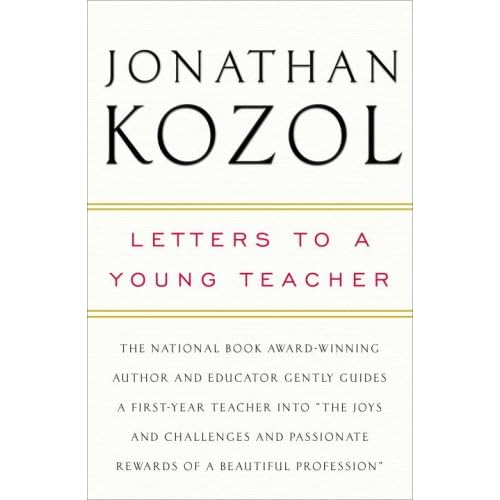
I've just greedily snatched from the interlibrary loan desk a book written by Jonathan Kozol just a few short months ago entitled ,"Letters to a New Teacher," which I have been quite excited to open. Here are a few passages within the first few pages that I already find quite compelling:
"It's a humbling experience, but I think that it's a good one too, for someone who writes books on education to come back into the classroom and stand up there as a teachers does day after day and be reminded in this way of what it's like to do the real work of a teacher. I sometimes think that every education writer, every would-be education expert, and every politician who pontificates, as many do so condescendingly, about the "failings" of the teachers in the front lines of our nation's public schools ought to be obliged to come into a classroom once a year and teach the class, not just for an hour with the TV cameras watching but for an entire day, and find out what it's like. It might at least impart some moderation to the disrespectful tone with which so many politicians speak of teachers."
"In my writings through the course of nearly 40 years, I have always tried to bring the mighty and ferocious educational debates that dominate the pages of the press and academic publications, in which the voices of our teachers are too seldom heard, back from the distant kingdom of intimidation and abstraction-- lists of "mandates," "sanctions," and "incentives" and "performance standards" and the rest-- into the smaller, more specific world of colored crayons and chalk erasers, pencil sharpeners, and tiny quarrels, sometimes tears and sometimes uncontrollably contagious jubilation of which daily life for the real teacher and her students is, in fact, composed."
"But teachers, and especially the teachers of young children, are not servants of the global corporation nor drill sergeants for the state and should never be compelled to view themselves that way. I think they have a higher destiny than that. The best of teachers are not merely the technicians of proficiency; they are also ministers of innocence, practitioners of tender expectations. They stalwartly refuse to see their pupils as so many future economic units for a corporate society, little pint-sized deficits or assets for America's economy, into whom they are expected to pump "added value," as pundits of the educational policy arena now declaim. Teachers like these believe that every child who has been entrusted to their care comes into their classroom with inherent value to begin with."
Just five pages in, I am already enthralled with the beauty of Kozol's writing and his fierce tenderness for teachers, children, and the classroom. I have a feeling I will be aquiring a new favorite...
***Kozol, Johnathan. Letters to a Young Teacher. New York: Crown Publishers, 2007


