"From the time they were babies, I wish our students saw the faces of people with their skin color and of the ethnicity in movies and on calendars, on postcards and in film. What a difference it would make if voices with a dialect, accent, and language like their own were part of their school lives from kindergarten on. And such pictures, such voices, would not be segregated to part of the school, the month, or the year. They would be there all year round, woven into the everyday: of doors-opening-bells-ringing-large-orange-buses-pulling-up-to-the-brick-building-in-the-dead-of-a-winter-night-morning..."
" '...There was a hit song by James Brown which had that line [With your Badd Self], so it was a slang term, but this man made literature out of it and that really enabled me. It opened up a door and said, "Wait a minute! There's poetry in the language I speak. There's poetry, therefore, in my culture and in this place." '
I want, more than anything as a teacher, to bring to the foreground the poetry in the language of my students."
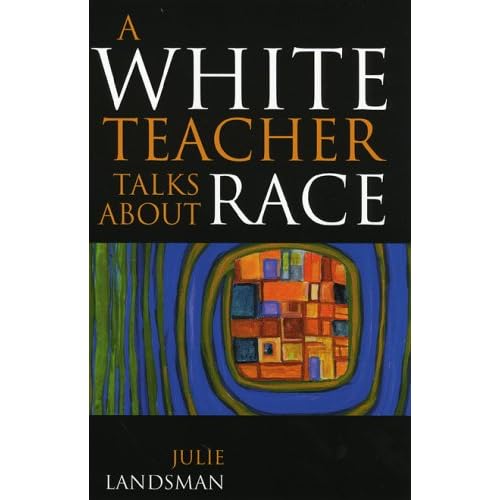
A required reading for my Instruction and Management in Education class is Julie Landsman's book, "A White Teacher Talks About Race," from which the above excerpt is taken. The quotation she cites comes from an interview with the author of Makes Me Wanna Holler, Sekou Sundiata conducted by Bill Moyers.
I have found this book to be extremely compelling in its compassionate dealings with the issue of race in the school. Unlike many articles and books I have been required to read for similar classes, this book does not come with the charge that we ought to "respect diversity" or be aware of "differences" in our classroom spoken in an overly-PC tone. This teacher's perspective is nearly heartbreaking as she recounts her own grievances over the hurt and struggle of her own students.
A large portion of the section I have read in the first third of the book deals with the reality that students who are not middle-class white children are starved of significant examples of their own people as significant members of society. These students do not see the familiar faces of their ancestors and cultural brothers and sisters in the context of success or significance.
The author recounts and experience in which she accompanies a student of Hmong descent to a play put on the people of her own culture. The student's very young brother joins the teacher and sister at the performance and is extremely distracted (as most young children are at such events) during the portions spoken in English, but intensely tuned into the parts of the performance in which the familiar Hmong language is spoken.
There is something empowering and comforting when we encounter something familiar to us, isn't there? This story in the book instantly reminded me of my own experiences last spring and summer when I would meet someone from Colorado or when I saw a movie filmed here-- even something as small as the culture of this state did something in me that at once brought me back to all sorts of feelings of home, familiarity, and rightness. As white people, we do not understand what it is like not to feel at home here, do we? It is easy to forget, difficult to imagine what it must be like for someone born in this country to lack the familiarity of faces in history like his or her own. Students need that safety and comfort found in the familiarity of their own families, this message that they do belong, regardless of what they and their predecessors have been told for too long. We all need to know that we belong, don't we?
Landsman makes a compelling point with anecdotes from the lives of many students that when a student is able to see him or herself in another, in a hero, a role model, there is something extremely empowering in that experience. There is this unspoken message that they too can become like this, there is hope for them too as they see their story in the story of another. It is so easy to forget the importance of showing students their own lives in the experiences of those like them that have come before-- maybe this is the place where we are most strongly able to communicate their value and worth.
I love this line from Sekou Sundiata: "There is poetry in the language I speak." As I read this, I realized that more than anything, I want my own students to be able to say this of themselves. For students, no matter their race or background, to realize that there is beauty in who they are is something miraculous and so deeply needed. It is something I need-- to see that there is beauty in me, in this very moment, that I am acceptable and free from shame regardless of what I have been told.
As we are often encouraged in our undergrad to "steal" the ideas that we like, I am stealing Landsman's thoughts (although this has been simmering in me for a while): I want, more than anything as a teacher, to bring to the foreground the poetry in the language of my students.
Landsman, Julie. "A White Teacher Talks About Race." Scarecrow Education, 2001: 27, 39


